Get free quotes from specimen courier service near you
Takes about a minute. Free, no obligation; providers reply to you directly.
The call came in at 11:47 PM on a Tuesday. A hospital lab in Columbia, South Carolina had a tissue biopsy that needed to reach a reference lab in Charlotte by 6 AM — or the sample was compromised and a patient’s cancer diagnosis got delayed by days. The lab manager had assumed their “regular courier” handled overnight runs. They did not.
That kind of gap is how specimen integrity fails. Not in dramatic fashion — no explosions, no obvious negligence — just a quiet chain of assumptions that nobody bothered to verify until the moment it mattered most.
If you’re a lab director, hospital administrator, or clinic manager trying to figure out how medical specimen couriers actually work — what they’re required to do, how to vet them, and what separates a compliant service from a liability risk — this is the guide I wish had existed when I started asking those questions.
The Short Version:Medical specimen couriers are specialized logistics providers trained for HIPAA, HAZMAT, and DOT compliance. They’re not general delivery services wearing scrubs. The right provider has documented chain-of-custody, temperature monitoring, STAT capability, and certified drivers. Expect custom pricing based on route complexity and urgency — there are no flat rates.
Key Takeaways
- Specimen viability depends on delivery windows measured in hours, not days — STAT services and 24/7 coverage aren’t upsells, they’re baseline requirements
- Chain-of-custody documentation is non-negotiable for CAP and CLIA compliance audits
- Drivers need HAZMAT certification and HIPAA training — these are distinct credentials, and many general couriers have neither
- Temperature control isn’t just refrigeration — it’s real-time monitoring with escalation protocols when thresholds are breached
What Medical Specimen Couriers Actually Do
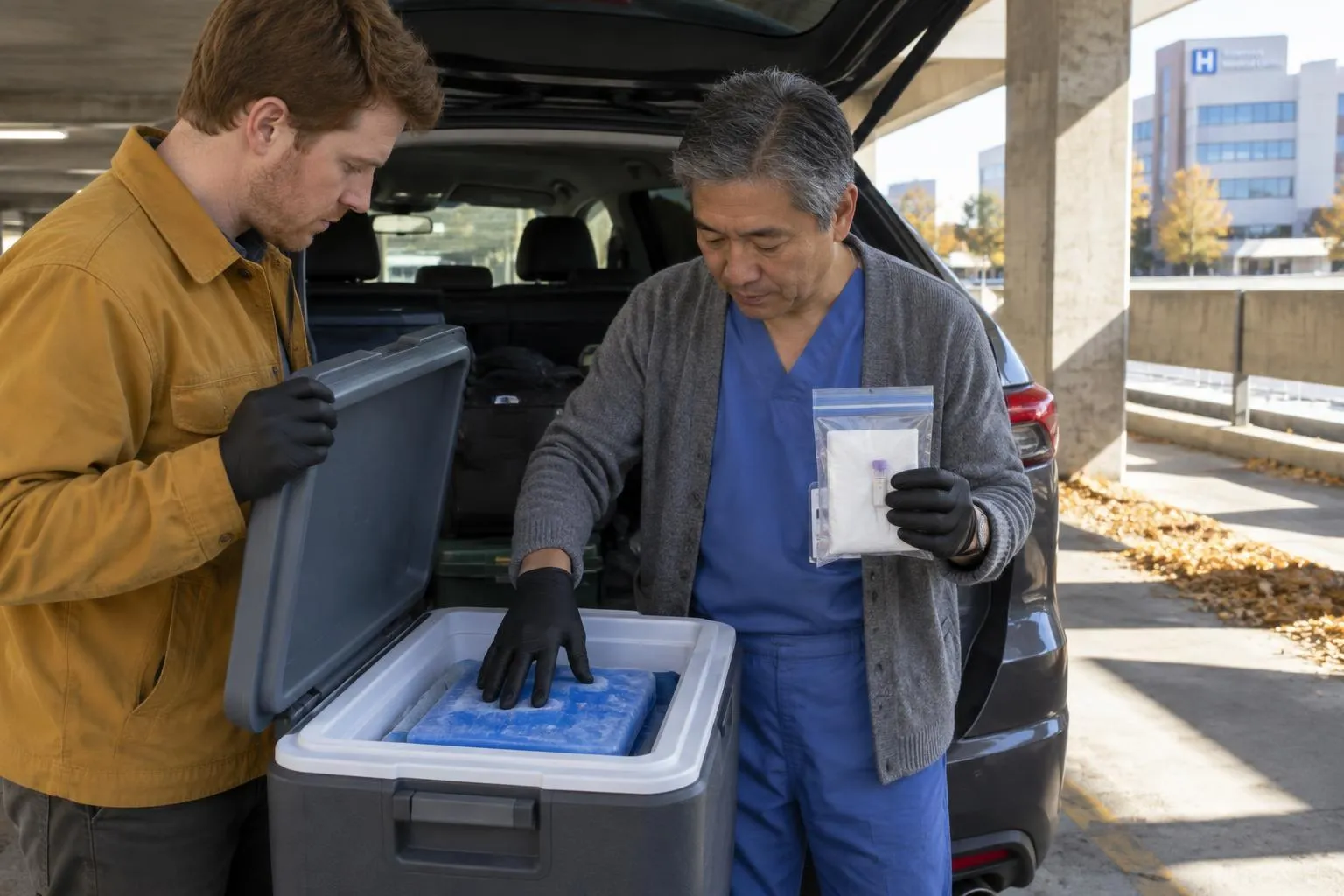
Here’s what most people miss: a medical specimen courier isn’t a FedEx driver with a cooler bag. The job involves handling biohazardous materials — blood samples, tissue biopsies, urine cultures, DNA materials, sometimes organs — under strict regulatory frameworks including DOT/PHMSA hazardous materials rules, IATA standards for biological substances (UN 3373 Category B), and OSHA bloodborne pathogen protocols.
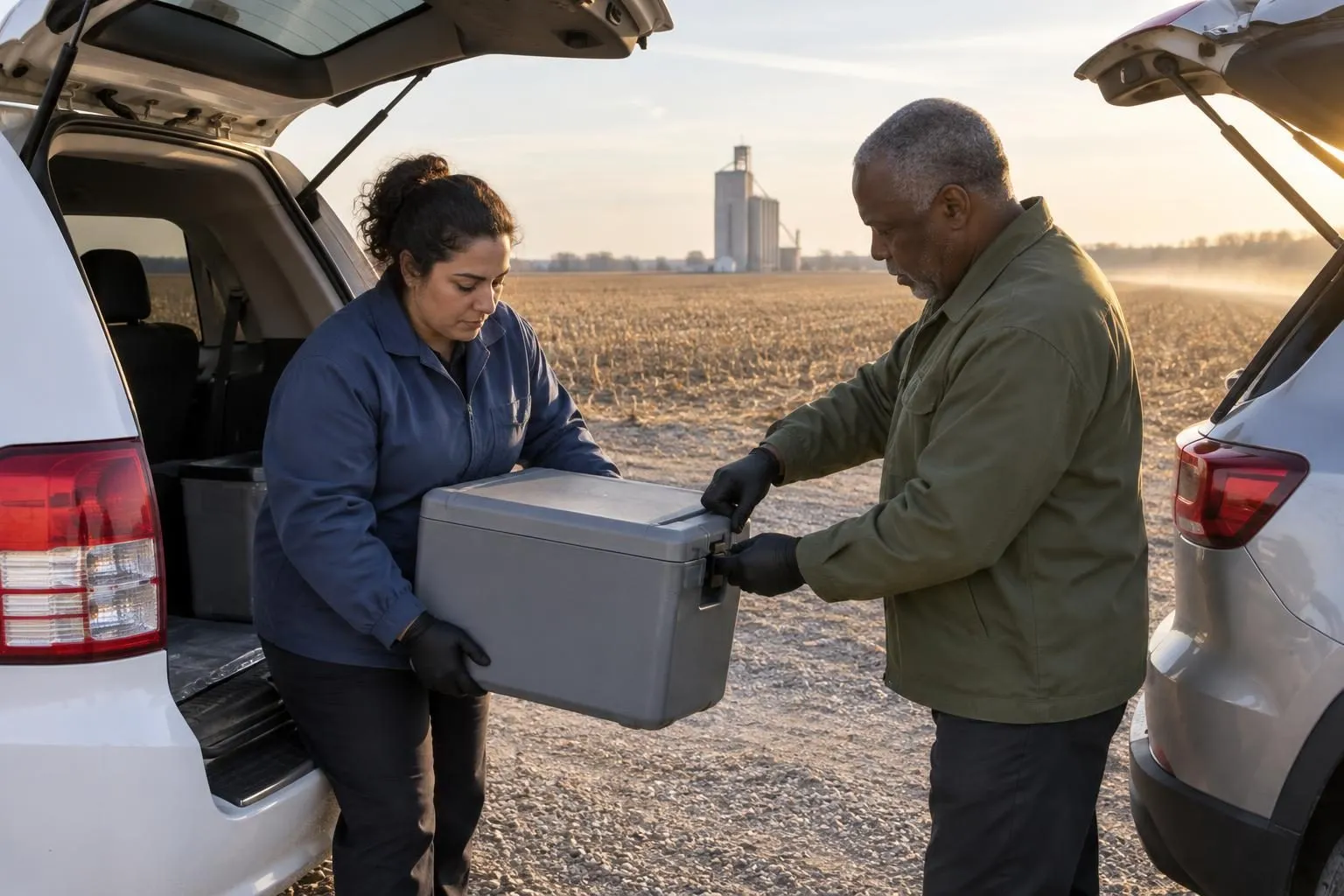
The transport chain starts at the collection site — a clinic, hospital phlebotomy station, or surgical suite — and ends at a reference laboratory. Every handoff in between needs to be logged. Every temperature deviation needs to be flagged. Every delay needs a documented explanation.
That’s the job. It’s, as one healthcare logistics professional put it, “far removed from simple delivery.”
Core services a credentialed provider should offer:
- Same-day and STAT pickup/delivery — urgent specimens with delivery windows sometimes under two hours
- Scheduled route service — recurring daily or multi-daily pickups for high-volume labs and hospital networks
- Temperature-controlled transport — ambient, refrigerated (2–8°C), or frozen, depending on specimen type
- After-hours and emergency coverage — weekend and overnight availability for time-sensitive cases
- Real-time tracking — GPS-monitored vehicles with temperature logging and delivery status updates
- Chain-of-custody documentation — timestamped records of every handler, transfer location, and condition check
The Certifications That Actually Matter
The industry has a compliance alphabet soup problem. Here’s what the credentials mean in practice:
HAZMAT Certification — Required by DOT for anyone transporting biological substances. Covers packaging requirements, labeling, and emergency procedures. This is a federal requirement, not optional.
HIPAA Compliance — Couriers who handle patient-identifiable information (which accompanies most specimens) need documented HIPAA training and business associate agreements with client facilities.
OSHA Bloodborne Pathogen Training — Standard 29 CFR 1910.1030 requires specific protocols for handling materials that may contain blood or other potentially infectious material. A driver moving blood samples without this training is a compliance violation waiting to happen.
CAP/CLIA Audit Readiness — Laboratories accredited by the College of American Pathologists or certified under CLIA need their transport chain to hold up under audit. That means your courier’s chain-of-custody records need to be audit-ready, not just “we have a log somewhere.”
Reality Check:Asking a courier “are you HIPAA compliant?” and getting a “yes” is not due diligence. Ask to see their business associate agreement template, their HAZMAT certification documentation, and their chain-of-custody record format. A legitimate provider has these ready. One that hesitates probably shouldn’t be handling your specimens.
Service Types: A Comparison
Not all specimen transport needs are the same. Here’s how the main service categories stack up:
| Service Type | Typical Use Case | Speed | Temperature Control | Cost Tier |
|---|---|---|---|---|
| STAT / Emergency | Urgent biopsies, organs, critical labs | 1–4 hours | Required | Highest |
| Same-Day Scheduled | High-priority specimens with known pickup time | 2–8 hours | Required | High |
| Routed Daily Run | Routine lab work, recurring clinic pickups | Same business day | Varies by specimen | Moderate |
| Overnight / Next-Day | Non-urgent reference lab submissions | 12–24 hours | Often required | Moderate |
| Long-Haul / Interstate | Regional reference lab networks | 24–72 hours | Required | Varies |
| Courier + Storage | Equipment storage + time-critical delivery | Flexible | Facility-dependent | Custom |
Regional providers like DASH Courier (serving North and South Carolina cities including Charleston, Columbia, and Greenville) offer the full stack — 24/7 HIPAA and HAZMAT certified services for hospitals, labs, and pharmacies. National providers like Stat Experts cover U.S.-wide pickup and delivery and add equipment storage for clients with complex logistics needs. Mayo Clinic Laboratories, for context, maintains contracted courier networks with strict packaging guidelines and dedicated contact lines (800-533-1710 domestic, +1 855-379-3115 international) — a model that shows what systematic courier management looks like at scale.
What to Expect on Pricing
I’ll be honest: you will not find a rate card for medical specimen courier services. That’s intentional, not evasive.
Pricing is built around variables that genuinely affect service cost:
- Urgency — STAT runs command a significant premium over scheduled routes
- Distance — local hospital-to-lab vs. interstate reference lab runs
- Temperature requirements — refrigerated transport involves specialized vehicles and equipment
- Volume — high-frequency recurring routes get negotiated rates; one-off pickups do not
- After-hours surcharges — 24/7 availability isn’t free to provide
The honest answer is that any provider quoting you a flat rate without understanding your route complexity and specimen requirements is either guessing or not thinking through their costs. Get custom quotes from at least three providers. Compare them on compliance documentation, not just price.
Pro Tip:When soliciting quotes, give providers your actual specimen types, pickup locations, frequency, and any after-hours requirements upfront. Vague RFPs get vague pricing. Specific requirements get accurate quotes — and reveal quickly which providers have done this before.
Chain of Custody: The Detail That Decides Audits
Mercury, a medical logistics provider, frames it plainly: “Without clear records, it becomes much harder to investigate delays.”
That’s an understatement in the context of a CAP audit or a patient safety incident review.
Chain-of-custody documentation should capture:
- Who collected the specimen and when
- Who picked it up (driver ID, vehicle ID)
- Transfer timestamps at every handoff
- Temperature readings throughout transport
- Delivery confirmation with recipient signature
When something goes wrong — a delayed result, a compromised sample, a question about specimen identity — the chain-of-custody record is the first document anyone asks for. If your courier can’t produce one, you have a problem that extends well beyond the individual incident.
Real-time GPS tracking and temperature monitoring aren’t just nice-to-have features. They’re the mechanism by which you verify the chain of custody is being maintained, not just documented after the fact.
Equipment and Technology Standards
The vehicle is not just a van. A properly equipped medical courier vehicle includes:
- Temperature-controlled compartments with logging capability — passive insulated containers are insufficient for many specimen types
- GPS tracking integrated with dispatch software
- Tamper-evident packaging materials for biological specimens
- Spill containment kits and biohazard disposal supplies per OSHA standards
- Mobile communication for real-time status updates and escalation
On the technology side, carGO Health emphasizes that temperature-controlled transport is “essential” for vaccines and biological specimens — and the operative word is controlled, meaning actively monitored and logged, not just “we put it in a cooler.”
The difference between a cooler with ice and a calibrated temperature-controlled container with a data logger is the difference between specimen integrity you can prove and specimen integrity you’re hoping for.
State Regulations and Interstate Transport
Intrastate specimen transport is primarily governed by OSHA and DOT regulations, with additional licensing requirements varying by state. Interstate transport of biological substances triggers federal DOT/PHMSA rules regardless of state lines crossed.
Key regulatory frameworks:
- DOT 49 CFR Part 173 — packaging and labeling requirements for biological substances
- IATA Dangerous Goods Regulations — applies when air transport is involved
- OSHA 29 CFR 1910.1030 — bloodborne pathogen standard for handlers
- State health department regulations — vary; some states have additional licensing requirements for clinical specimen transport
If your specimens are crossing state lines — which happens regularly with reference lab networks — verify explicitly that your courier has interstate operating authority and current DOT compliance.
Future Trends Worth Watching
The medical courier space is moving toward tighter technology integration and stricter documentation standards — driven partly by the shift toward precision medicine, where sample integrity is even more critical, and partly by increased regulatory scrutiny post-pandemic.
Three developments to track:
Automated temperature monitoring — IoT sensors that log and transmit real-time data throughout transport, with automatic alerts at threshold deviations, are becoming baseline expectation rather than premium feature.
Route optimization for specimen viability — software that accounts not just for distance but for specimen-specific delivery windows is making STAT logistics more predictable.
Expanded same-day reference lab networks — as regional reference labs grow, the demand for high-frequency, STAT-capable courier routes is increasing, particularly in mid-sized metro areas.
How to Hire the Right Courier
The selection process should be systematic, not casual. Here’s the framework:
- Define your specimen types and transport requirements — temperature needs, delivery windows, frequency, geographic coverage
- Request compliance documentation upfront — HAZMAT certs, HIPAA BAA, OSHA training records, chain-of-custody sample forms
- Ask about escalation protocols — what happens when a driver is delayed? When a temperature excursion is detected?
- Verify after-hours coverage — get the actual contact number, not just “we have 24/7 service”
- Check references from facilities similar to yours — a courier serving a dermatology clinic and one serving a hospital oncology lab are not equivalent
- Review the tracking interface — you should be able to see specimen location and status in real time, not just on request
Practical Bottom Line
The medical specimen courier market has no shortage of providers willing to pick up your samples. The shortage is in providers who can prove they’re doing it right.
For your next steps:
- If you’re evaluating a new provider, start with compliance documentation — ask for HAZMAT certification, HIPAA BAA, and a sample chain-of-custody form before any pricing discussion
- If you’re auditing your current provider, pull three months of chain-of-custody records and check for completeness — gaps there are gaps in your compliance posture
- If you need after-hours or STAT capability, test it before you need it — call the after-hours line during business hours and see what actually happens
For more on how to evaluate specific service types, see our guide to STAT medical courier services and the medical courier compliance checklist we put together for lab administrators working through CAP audit prep.
The stakes are simple: specimens that arrive on time and in condition get results. Ones that don’t get retests, delays, and sometimes worse. The courier is the link in the chain nobody thinks about until it breaks.
Done reading? Get quotes from medical specimen couriers near you.
Takes about a minute. Free, no obligation; providers reply to you directly.
Popular cities:
Nick built this directory to help lab managers and hospital procurement teams find credentialed specimen couriers without relying on word-of-mouth — a gap he discovered after a reference lab lost a critical oncology biopsy due to an uncertified transport vendor with no documented chain of custody.